
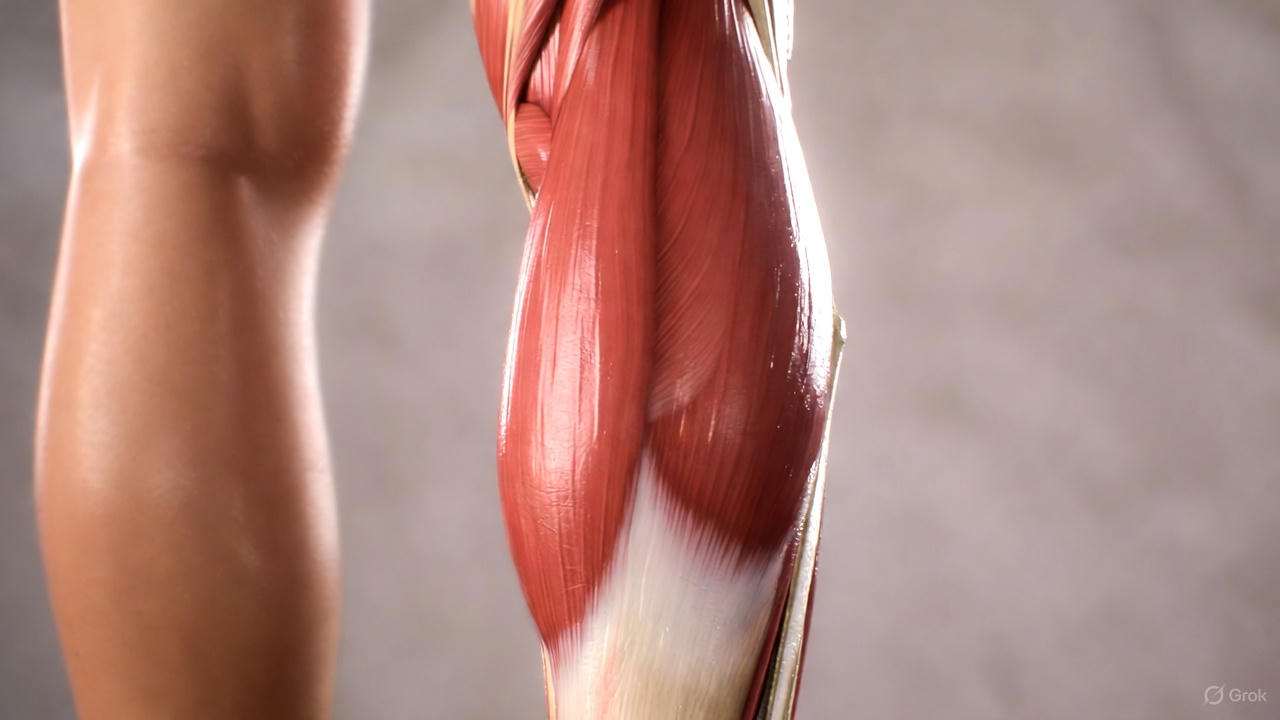
Do the calves play a role in insulin sensitivity? The gastrocnemius muscle, the prominent superficial muscle of the posterior calf, is often appreciated primarily for its mechanical contributions to locomotion. However, emerging research demonstrates that it also plays a meaningful role in systemic glucose homeostasis and insulin sensitivity.
Although the calves represent a relatively small fraction of total skeletal muscle mass, its frequent recruitment during daily activities and its unique fiber-type composition make it a noteworthy contributor to metabolic health. This article looks at the calf – insulin axis, and reviews the recent science tying the two together.
Skeletal Muscle as the Primary Site of Insulin-Mediated Glucose Disposal
Skeletal muscle accounts for approximately 80–85% of insulin-stimulated glucose uptake following a meal. Greater muscle mass and higher insulin sensitivity within muscle tissue reduce the demand on pancreatic β-cells and attenuate postprandial glycemic excursions. The gastrocnemius, composed of both slow-twitch (Type I) and fast-twitch (Type II) fibers, participates actively in this process and responds robustly to exercise training.
Mechanisms of Improved Insulin Sensitivity in the Gastrocnemius
- Exercise-Induced GLUT4 Translocation
Muscle contraction stimulates translocation of glucose transporter type 4 (GLUT4) to the sarcolemma independently of insulin. This effect is pronounced during and for several hours after exercise, significantly enhancing glucose uptake.
Reference: Cartee GD. Mechanisms for greater insulin-stimulated glucose uptake in trained skeletal muscle. J Appl Physiol (1985). 2021;130(6):1683-1692. https://pmc.ncbi.nlm.nih.gov/articles/PMC8260367/ - Reduction in Retinol-Binding Protein 4 (RBP4)
Endurance training has been shown to decrease intramuscular and circulating RBP4 concentrations, a protein strongly implicated in the pathogenesis of insulin resistance.
Reference: Yang Q, et al. Endurance exercise training decreases retinol-binding protein 4 expression in gastrocnemius muscle of obese rats. Physiol Rep. 2018;6(18):e13847. https://pmc.ncbi.nlm.nih.gov/articles/PMC6167634/ - Myokine Secretion
Contracting skeletal muscle, including the gastrocnemius, releases myokines (e.g., IL-6, irisin, meteorin-like) that exert anti-inflammatory and insulin-sensitizing effects on adipose tissue, liver, and pancreas.
Reference: Pedersen BK, Febbraio MA. Muscle as an endocrine organ: focus on muscle-derived interleukin-6. Physiol Rev. 2008;88(4):1379-1406. https://pubmed.ncbi.nlm.nih.gov/18923185/ - Fiber-Type Adaptations
Regular training increases mitochondrial density and oxidative capacity, particularly in Type II fibers, which are abundant in the gastrocnemius and typically exhibit lower baseline insulin sensitivity.
Reference: Stuart CA, et al. Human muscle fiber type-specific insulin signaling. Diabetes. 2015;64(2):485-497. https://diabetesjournals.org/diabetes/article/64/2/485/34059/
Quantifiable Metabolic Benefits
- A single 10–15-minute bout of light-to-moderate activity after meals can reduce postprandial glucose by 20–30% and insulin excursions by 30–50% in individuals with and without type 2 diabetes.
Reference: Colberg SR, et al. Postprandial walking is better for lowering the glycemic effect of dinner than pre-dinner exercise in type 2 diabetic individuals. J Am Med Dir Assoc. 2013;14(7):515-519. https://pubmed.ncbi.nlm.nih.gov/19560716/ - Structured programs combining aerobic and resistance exercise routinely reduce insulin requirements by 30–58% in patients with type 2 diabetes, with some individuals discontinuing insulin entirely when combined with dietary optimization.
Clinical and Practical Implications
Incorporating activities that recruit the gastrocnemius—walking, stair climbing, standing calf raises, jump rope, or loaded heel raises—into daily routines provides cumulative metabolic benefits disproportionate to the modest muscle mass involved. Post-meal movement, in particular, represents one of the most potent non-pharmacological interventions available for blunting glycemic spikes.
The gastrocnemius should therefore be regarded not merely as a locomotor muscle, but as an active participant in glucose regulation and insulin sensitivity. Targeted activation of this muscle through regular physical activity constitutes a practical, evidence-based strategy for improving metabolic health.
