
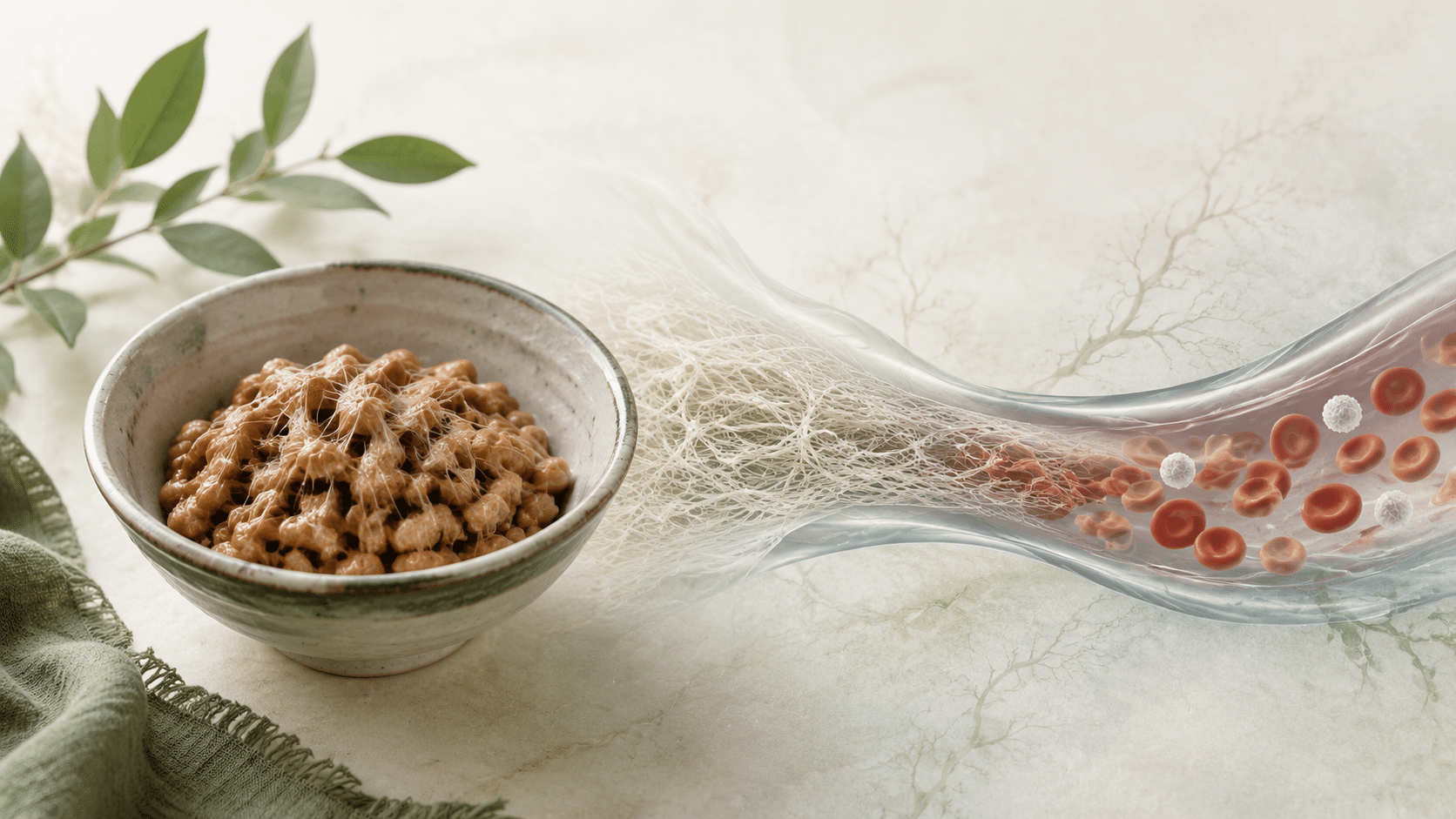
Nattokinase benefits and risks deserve a more careful discussion than supplement marketing usually provides. A number of people close to me — friends and family — have had sudden blood clots this year, with no single obvious cause. That sent me back into the research below: not to alarm anyone, but to examine what the human evidence actually shows, where these enzymes may fit, and where real prevention begins.
Fibrin is repair material. Your body lays it down to patch a cut, then plasmin and tPA clear the leftover mesh so blood can keep moving. That cleanup slows when the vessel lining is inflamed, insulin is running high, sleep is short, or the gut is sending inflammatory signals into the blood. Three enzymes get discussed below. None of them is where we start.
Three enzymes at a glance
| Enzyme | Best evidence for | Strength of evidence | Typical studied dose |
|---|---|---|---|
| Nattokinase | Blood pressure (systolic & diastolic reduction) | Good multiple RCTs, 2023 meta-analysis of 546 adults | 2,000 FU/day (sometimes 4,000) |
| Lumbrokinase | Fibrinogen/viscosity, post-stroke adjunct care | Preliminary mostly China-based RCTs, quality varies | 300,000–600,000 units, 2–3×/day |
| Serrapeptase | Post-surgical swelling, sinus mucus (historical use) | Weak 2013 systematic review found evidence insufficient | 10,000–60,000 SPU/day |
Nattokinase benefits and risks: what we check first
“My blood feels thick” isn’t a lab value, and neither is a supplement label. Before any enzyme is worth discussing, we want to know whether fibrin burden is actually elevated, and what’s driving it. That usually means fasting insulin and HOMA-IR (is this insulin resistance), hs-CRP (how much inflammatory load is circulating), fibrinogen itself (it’s both a clotting factor and an acute-phase inflammatory protein, so a high number points upstream, not just at the blood), and homocysteine (a methylation and vascular-stress marker worth knowing regardless). A blood pressure trend over a few weeks matters more than one office reading.
Two people can walk in with the same “sticky blood” complaint and need almost opposite plans — one driven by metabolic dysfunction, one by chronic inflammation, one by a stress-and-sleep pattern that isn’t showing up on a lipid panel at all. The enzyme, if there is one, comes after that picture is clear.
PAI-1 — the brake on fibrinolysis — rises with insulin resistance and inflammatory cytokines. Stress hormones shift clotting in the same direction. Blood gets a little thicker. Pressure creeps.
That is when people start shopping “kinase” enzymes. Three names sit in the same aisle. They are not interchangeable, and their labels do not convert into one another.
Nattokinase — fermented soy, best everyday data
A single serine protease from Bacillus subtilis natto. A capsule is not a bowl of natto. The food also carries vitamin K2 (MK-7). A quality supplement is labeled in fibrinolytic units (FU), not milligrams. Many purified forms, including NSK-SD, have the K2 removed — relevant if you take warfarin.
The strongest human finding is blood pressure. A 2023 systematic review and meta-analysis found modest reductions in systolic and diastolic pressure. An eight-week randomized, double-blind trial at 2,000 FU/day in prehypertension or stage 1 hypertension reported changes of roughly −5.6/−2.8 mmHg versus placebo. Real, modest, in the same range as cutting sodium. The meta-analysis also noted a small rise in blood glucose. This is not a blood-sugar therapy.
Blood pressure change vs. placebo
mmHg reduction across two nattokinase studies
Sources: 2023 meta-analysis · 2008 randomized trial.
Response varies person to person, and that’s not random: someone whose fibrinolysis is being held back mainly by insulin-resistance-driven PAI-1 has more room to move than someone whose metabolic picture is already clean.
A single oral dose can raise D-dimer and fibrin-degradation products for several hours. Over weeks, small studies have lowered fibrinogen and factors VII and VIII. That supports healthier flow. It does not prove a capsule will dissolve a clot, treat a stroke, clear “microclots,” or replace an anticoagulant.
A 12-month report at 10,800 FU/day described less carotid plaque. That dose is far above most bottles, and the study was not a blinded outcome trial. By contrast, a three-year randomized trial at 2,000 FU/day in lower-risk adults did not slow carotid thickening. Do not stop a statin on the strength of the observational report.
Typical studied dose: 2,000 FU daily (sometimes 4,000). Enteric-coated. Empty stomach. Recheck blood pressure at eight weeks.
Lumbrokinase — earthworm enzymes, different units, different papers
A mix of proteases from Lumbricus rubellus, not one molecule. Labels use IU, LKU, or “units.” Those units do not convert to nattokinase FU. “Thirty times stronger” is marketing, not a conversion you can use.
The human literature clusters around fibrinogen, blood viscosity, and ischemic-stroke adjunct care, much of it from China. One 12-month trial in 310 people after ischemic stroke used 600,000 units three times daily and reported lower fibrinogen plus some carotid and event-rate signals. A 2025 meta-analysis of 35 RCTs as add-on therapy in acute ischemic stroke reported better functional scores without a clear rise in GI bleeding; the included trials vary in quality. A 10-person open angina study is a pilot. A Long-COVID/Lyme/ME-CFS study is still open-label. This is not proven prevention of heart attack or stroke.
And a fibrinogen number that won’t come down on its own is a reason to look harder at inflammatory drivers — hs-CRP, gut permeability, chronic infection load — not just to reach for the enzyme that lowers it on paper.
Typical range in studies and clinic use: 300,000–600,000 units, two or three times daily, empty stomach, enteric or delayed-release. Match the unit system on that bottle.
Serrapeptase — the “silkworm” enzyme, not a circulation protocol
Sold as silkworm kinase or silkworm enzyme. It is serrapeptase (serratiopeptidase), a zinc metalloprotease made by Serratia bacteria that live in the silkworm gut. The bacteria use it to help dissolve the cocoon. The capsule is not ground silkworm, and it is not the moth’s own cocoonase.
Measured in SPU or SU, not FU. Usual supplement range: 10,000–60,000 SPU, enteric-coated, empty stomach. Historically used in Japan and parts of Europe for postoperative swelling, dental inflammation, sinus and airway mucus. A 2013 systematic review found most trials methodologically weak, evidence insufficient to support it as an analgesic or general supplement, and inadequate long-term safety data. In-vitro fibrin activity is not cardiovascular outcome evidence.
If the question is blood pressure or fibrin burden, nattokinase has the human dataset. If the question is local swelling or thick mucus, that is a different conversation — and still not a reason to add it on top of a blood thinner without a plan.
Do not stack them
Two or three fibrinolytic enzymes is more bruising risk, not twice the proven benefit. Pick the enzyme that matches the job, or pick none.
Who should not start these on their own
⚠ Important: Do not add any of the three if you take warfarin, apixaban, rivaroxaban, dabigatran, or daily aspirin/clopidogrel unless the clinician who prescribed those drugs agrees and is watching you. Stop before surgery. Skip all three with a bleeding disorder, recent hemorrhagic stroke, active ulcer, or pregnancy. Skip nattokinase with a soy allergy. There is at least one published cerebellar bleed when nattokinase was stacked with aspirin.
A capsule is not first aid for chest pain, a swollen calf, sudden weakness, or a sudden severe headache.
Where this fits
Nattokinase is the first oral option when the question is everyday flow and blood pressure you can measure. Lumbrokinase is a supervised option when fibrinogen stays high and the unit on the bottle is clear. Serrapeptase is not a stand-in for either.
None of them fixes the reason blood got thick in the first place. That’s the slower work: daily movement, protein-forward meals that don’t spike insulin, consistent sleep, and bringing down inflammatory load through diet and gut health. An enzyme can support the mechanical cleanup once that work is underway. It doesn’t do the work for you, and it doesn’t replace finding out — through labs, not guessing — why fibrinolysis slowed down in the first place.
Bring your medication list in. We’ll look at fasting insulin, hs-CRP, fibrinogen, and homocysteine before deciding whether an enzyme earns a place in your plan — and if one does, which one, and at what dose.
FAQ
What’s the difference between nattokinase, lumbrokinase, and serrapeptase?
They’re not versions of the same thing. Nattokinase comes from fermented soybeans (natto) and has the largest human blood-pressure dataset. Lumbrokinase comes from earthworm proteases and is studied mainly for fibrinogen and post-stroke adjunct care. Serrapeptase comes from bacteria in the silkworm gut and has the weakest evidence overall — mostly historical use for swelling and mucus, not circulation. Their dosing units (FU, units/IU/LKU, SPU) don’t convert to one another.
Is taking a nattokinase capsule the same as eating natto?
No. Natto also delivers a large amount of vitamin K2 (MK-7), which most purified nattokinase supplements — including NSK-SD — have removed. That distinction matters if you take warfarin, since K2 affects how that medication works.
How long before I’d know if nattokinase is working?
Give it about eight weeks before judging its effect on blood pressure. That’s the timeframe used in the clinical trials, and it’s when we’d recheck your numbers.
Can I take more than one of these enzymes at the same time?
We don’t recommend stacking them. Combining two or three fibrinolytic enzymes raises bruising and bleeding risk without proven added benefit — pick the one that matches what your labs and symptoms actually point to.
Are these safe to take with blood thinners or daily aspirin?
Not without your prescribing clinician’s involvement. Don’t start any of the three if you take warfarin, apixaban, rivaroxaban, dabigatran, or daily aspirin/clopidogrel unless the clinician managing those medications knows and is monitoring you. There’s at least one published case of a cerebellar bleed when nattokinase was combined with aspirin.
What labs do you check before recommending one of these?
Typically fasting insulin (HOMA-IR), hs-CRP, fibrinogen, and homocysteine, plus a blood pressure trend rather than a single reading. That tells us whether fibrin burden is actually elevated and what’s driving it, so we’re not guessing between three different enzymes.
