
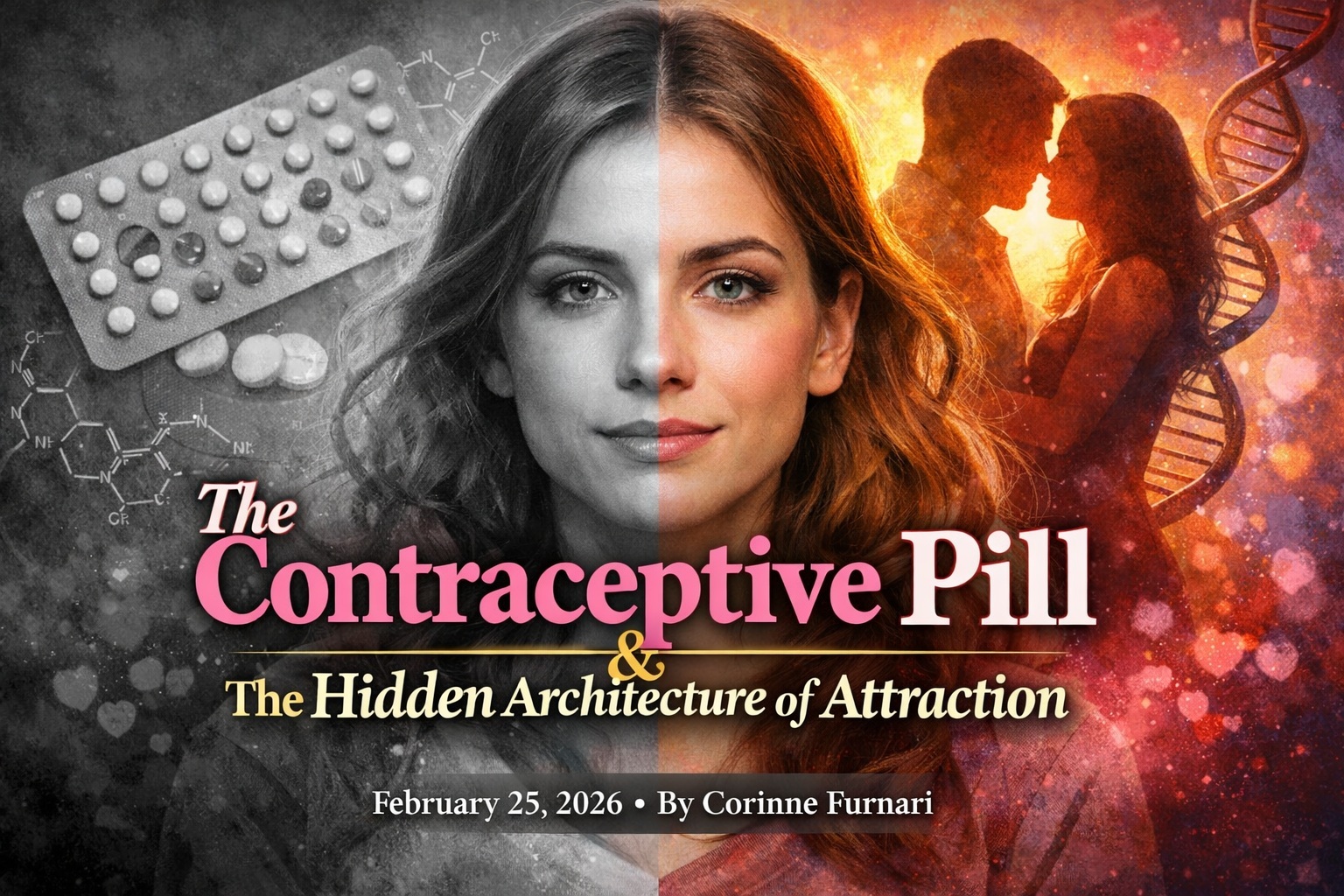
Understanding the link between the birth control pill and attraction is vital to explaining modern shifts in relationship dynamics. In 2009, economists identified a “Feminine Happiness Paradox.”
Despite the massive socio-economic leaps women have made since the 1970s—gains in education, legal rights, and career autonomy—subjective life satisfaction has steadily declined. While the world outside was being restructured for equality, a massive, population-scale chemical intervention was restructuring the female brain.
To understand why women initiate 70% of divorces (and 90% among the college-educated), we have to look past sociology and into the biology of hormonal contraception.
1. The “Grayscale” Effect on the Brain
The Birth Control Pill does more than suppress ovulation; it alters the Hypothalamic-Pituitary-Adrenal (HPA) axis, the body’s command center for stress and emotional learning.
In a natural cycle, cortisol spikes help us encode memories and sharpen attention—what researchers call a “Full Color” emotional life. Pill users often lack these spikes. Instead, their bodies show markers of a system attempting to shut itself down due to chronic activation. The result? A “Grayscale” existence where emotional intensity is dampened.
- Flattened Rhythms: Pill users lack the natural morning peaks and evening valleys of cortisol, resembling the physiological state of those with chronic trauma.
- Brain Vulnerability: Long-term use is associated with reduced volume in the hippocampus, the region essential for emotional regulation.
2. Why Visual Preferences Shift
Evolutionarily, the Pill places the body in a state resembling early pregnancy. Because a pregnant woman is no longer “in the market” for a mate, her psychology shifts from seeking high-quality genetic traits to seeking safety and provision.
| Feature | Natural Peak Fertility | Pill-Induced (Luteal) State |
| Facial Markers | High jaw height, prominent cheekbones | Softer, less masculine features |
| Symmetry | High sensitivity to symmetry | Reduced sensitivity |
| Behavioral Cues | Social dominance | Investment and reliability |
By mimicking pregnancy, the Pill chemically nudges women toward “stability” candidates, often at the direct expense of raw sexual chemistry.
3. The MHC Scent Reversal
Beyond what we see, the Pill disrupts what we smell. Humans naturally use scent to detect the Major Histocompatibility Complex (MHC)—genes that govern immune diversity. Naturally, women prefer men with different MHC genes to ensure healthy offspring.
However, because the Pill mimics pregnancy, it reverses this. Women on the Pill often shift toward preferring MHC-similar scents—the smell of “kin” who would traditionally provide tribal support.
The Biological Trap: If a woman meets a partner while on the Pill and later stops taking it, her natural drive for MHC-dissimilarity returns. This can lead to a sudden, confusing loss of physical attraction to a partner she previously “chose.”
4. How The Birth Control Pill Influences Sexual Satisfaction
Research suggests that women who meet their partners while on the Pill make a specific trade-off: Reliability vs. Desire.
- The Pros: These women report higher satisfaction with financial provision and partner faithfulness.
- The Cons: They experience significantly lower sexual attraction, lower frequency of sex, and less overall sexual satisfaction.
This “hollow achievement” explains why many women feel mismatched. They have secured the stability their “chemically pregnant” brain demanded, but find themselves at odds with their deeper biological drives.
5. The Birth Control Pill and Attraction: A 60-Year Psychological Blind Spot
Why isn’t this common knowledge? From the beginning, the Pill’s psychological side effects were dismissed. When early trial participants reported mood shifts and physical discomfort, researchers labeled them “at worst inconvenient.”
Today, the medical community often excludes Pill users from psychological studies because their “blunted” responses create “noisy” data. We are effectively removing the experiences of millions of women from our definition of “normal” psychology.
How The Birth Control Pill Impacts Choice
- The Stress Mask: The Pill may mute your emotional engagement with the world.
- Hijacked Attraction: Your “type” may shift from genetic quality to tribal stability.
- Biological Mismatch: Choosing a partner while on the Pill can lead to long-term sexual incompatibility.
- The Paradox: The women most likely to use the Pill (college-educated) are the same group experiencing the steepest declines in happiness.
Final Thoughts: The Birth Control Pill and Attraction
Ultimately, the “Feminine Happiness Paradox” may not be a mystery of sociology, but a consequence of biology. By decoupling sex from reproduction, the Pill offered women unprecedented external liberty, yet it may have simultaneously tethered them to an internal “grayscale” reality. When we chemically alter the very mechanisms—scent, sight, and stress—that help us navigate our most intimate choices, we risk building lives that look perfect on paper but feel hollow in practice. True progress requires more than just the autonomy to choose; it requires the biological clarity to ensure that those choices align with our deepest, most authentic selves.
