What Your Brain Knows About Hormones: Beyond the Hot Flash
For decades, the conversation around menopause has centered on hot flashes, leaving the complexities of the “menopausal brain” in the shadows. But for millions of women, cognitive challenges like brain fog and memory lapses are just as debilitating. This has led many to question the standard scripts and investigate the critical differences between Bioidentical vs. Synthetic Hormones.
Are all hormone therapies created equal, especially when it comes to brain health? A new wave of scientific evidence is beginning to draw a sharp distinction between “natural” bioidentical hormones and their synthetic counterparts. This article explores the debate of Bioidentical vs. Synthetic Hormones, revealing how the brain responds differently to each.
1. A Landmark Study: How Your Brain Responds to Real Hormones
A recent pilot study represents a significant breakthrough in understanding how hormones affect cognition. Researchers used functional MRI (fMRI) scans on 29 post-menopausal women to isolate the specific effects of bioidentical estradiol and progesterone on the brain.
The use of fMRI was key, as its sensitivity can detect subtle shifts in brain activation long before changes in behavior or performance become obvious. This allowed researchers to score the brain scan itself, not just the person’s performance on a test.
1.1 Progesterone: The Brain’s Memory Architect
The study revealed progesterone to be a major player in the brain’s memory centers. During a visual memory task, progesterone treatment was associated with greater activation in two critical areas: the left prefrontal cortex and, most importantly, the right hippocampus.
The right hippocampus is the brain’s “memory maker,” responsible for forming new visual memories. Activating this region suggests that progesterone is directly involved in regulating the circuits essential for memory encoding. This finding was reinforced by a key behavioral outcome: Only progesterone was linked to a statistically significant improvement in verbal working memory. This is the ability to hold a phone number in your head while you look for a pen.
Animal studies have long suggested that progesterone can act like “brain fertilizer,” promoting the health and growth of neurons. This study provides compelling evidence that in humans, it plays a vital role as a true architect of the mind.
1.2 Estradiol Hits the Gas, Progesterone Fine-Tunes the Engine
While progesterone built the architecture of memory, estradiol demonstrated a more specialized function, and the contrast between the two hormones was striking.
During verbal processing tasks, women who received estradiol showed greater activation in the left prefrontal cortex, the brain’s primary language center. This suggests estradiol acts as a kind of accelerator, hitting the gas to power the brain’s word-encoding functions. During the visual memory tasks, however, estradiol showed no significant difference in brain activation compared to a placebo.
Progesterone, meanwhile, employed a completely different strategy during the same verbal tasks. It was associated with decreased activation in the right prefrontal cortex. While a decrease might sound negative, it actually suggests improved neural efficiency—a more targeted and relaxed strategy.
2. The Critical Distinction: Bioidentical vs. Synthetic Hormones
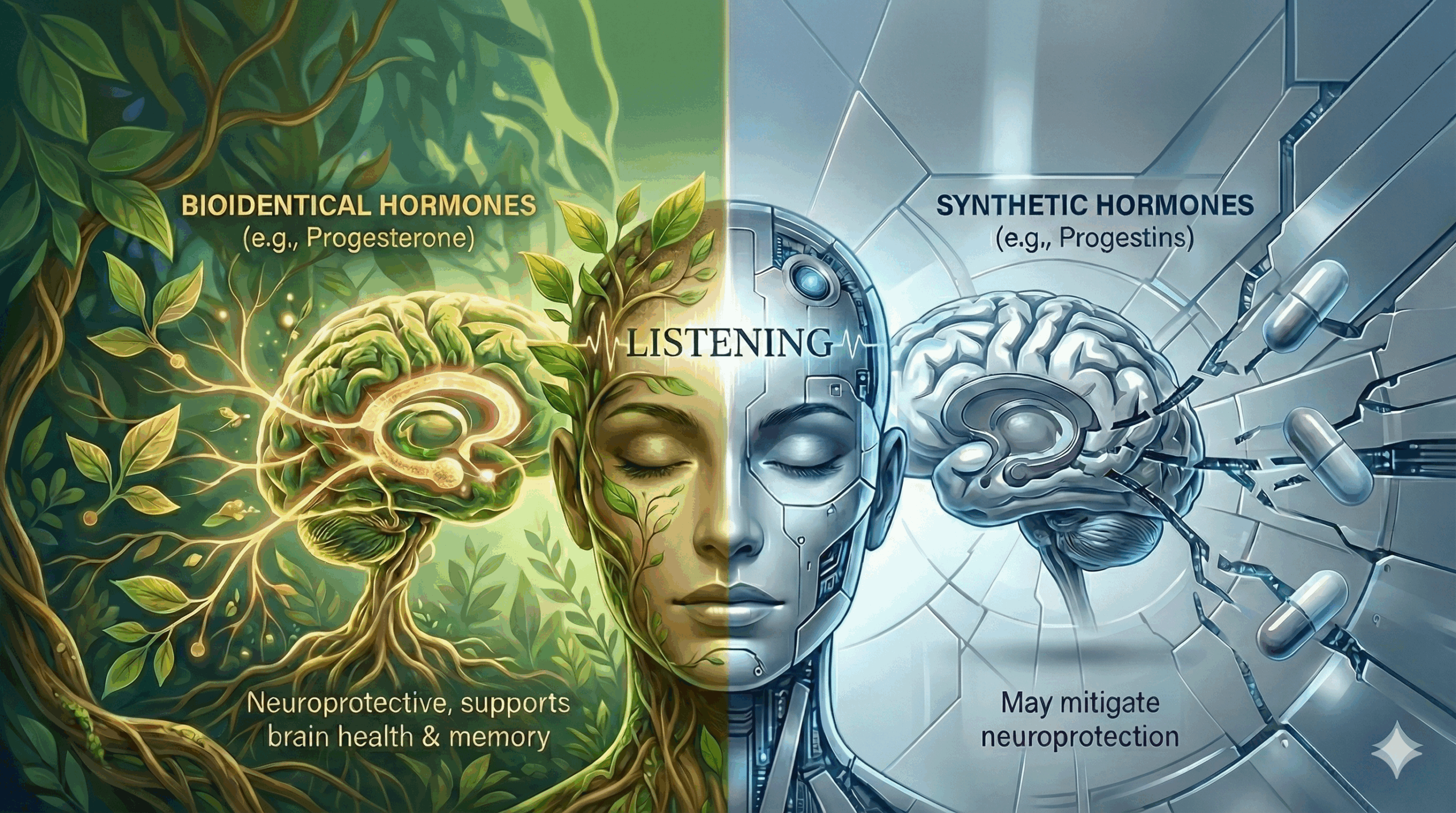
The most important takeaway from modern research is that the brain appears to know the difference. It is crucial to understand the battle of Bioidentical vs. Synthetic Hormones, specifically between bioidentical progesterone and synthetic versions known as progestins (like medroxyprogesterone acetate, or MPA).
Their effects on the brain are not just different; they can be opposing.
- Bioidentical Progesterone: Has been shown to be neuroprotective and to support the birth of new neurons (neurogenesis) in the hippocampus.
- Synthetic Progestins (MPA): Have been shown to reduce neurogenesis and can mitigate the neuroprotective benefits that estrogen provides.
In short, when comparing Bioidentical vs. Synthetic Hormones, one supports the brain’s ability to repair and grow, while the other may work against it.
3. The Patient Experience: Why Women are Demanding Better Options
The scientific data is mirrored in the real-world experiences of women, who are increasingly moving away from conventional hormone therapy and toward compounded bioidentical hormone therapy (CBHT).
3.1 The “Push” Away from Conventional Medicine
This push wasn’t a first resort; for the 62% of women who had already tried and been failed by over-the-counter herbal remedies, it was a search for something that was both natural and potent enough to work. The study identified three primary reasons women felt pushed away from standard treatments:
- Fear and Uncertainty (81%): The fallout from the Women’s Health Initiative (WHI) trials two decades ago has left a lingering fear regarding the safety of conventional therapy.
- Aversion to Specific Products (48%): Many women reported a strong aversion to conjugated equine estrogens (like Premarin).
- General Distrust (95%): A staggering number of women—over 95%—cited a fundamental distrust of biomedicine and the pharmaceutical industry.
3.2 The “Pull” Towards a Better Clinical Experience
While the primary “pull” motivations towards CBHT were its effectiveness and perceived safety, the study’s most profound finding was the desire for an enhanced clinical experience. Over 60% of women were drawn to clinicians who took the time for consultations that could last up to 90 minutes.
4. Practical Guide: Getting the Most from Your Therapy
For women using topical hormones, it’s important to know that “treatment failure” is often “application failure.” Proper absorption is critical.
The “Dinner Plate” Rule for Effective Absorption
- Use Thin Skin: Apply creams to areas with the thinnest skin, such as the inner arms, inner thighs, or belly.
- Spread It Out: Do not concentrate the cream in a small spot. Spread it over a surface area the size of a large dinner plate.
- Rotate Sites: You must rotate the application sites daily.
The “Interrupter Cycle” for Estrogen
To mimic the body’s natural cellular rhythms, estrogen cream requires a periodic break. A common protocol is to apply the cream for the first 25 or 28 days of the month and then stop until the 1st of the next month.
Conclusion: Your Brain is Listening
The evidence is mounting. The objective science shows that bioidentical progesterone is a key player in brain health. At the same time, the patient experience reveals a powerful desire for a respectful, collaborative clinical relationship.
We are entering a new era where the choice of Bioidentical vs. Synthetic Hormones should be viewed through the lens of long-term neuroprotection. Contact us today to learn more about your options and how to protect your cognitive health.