
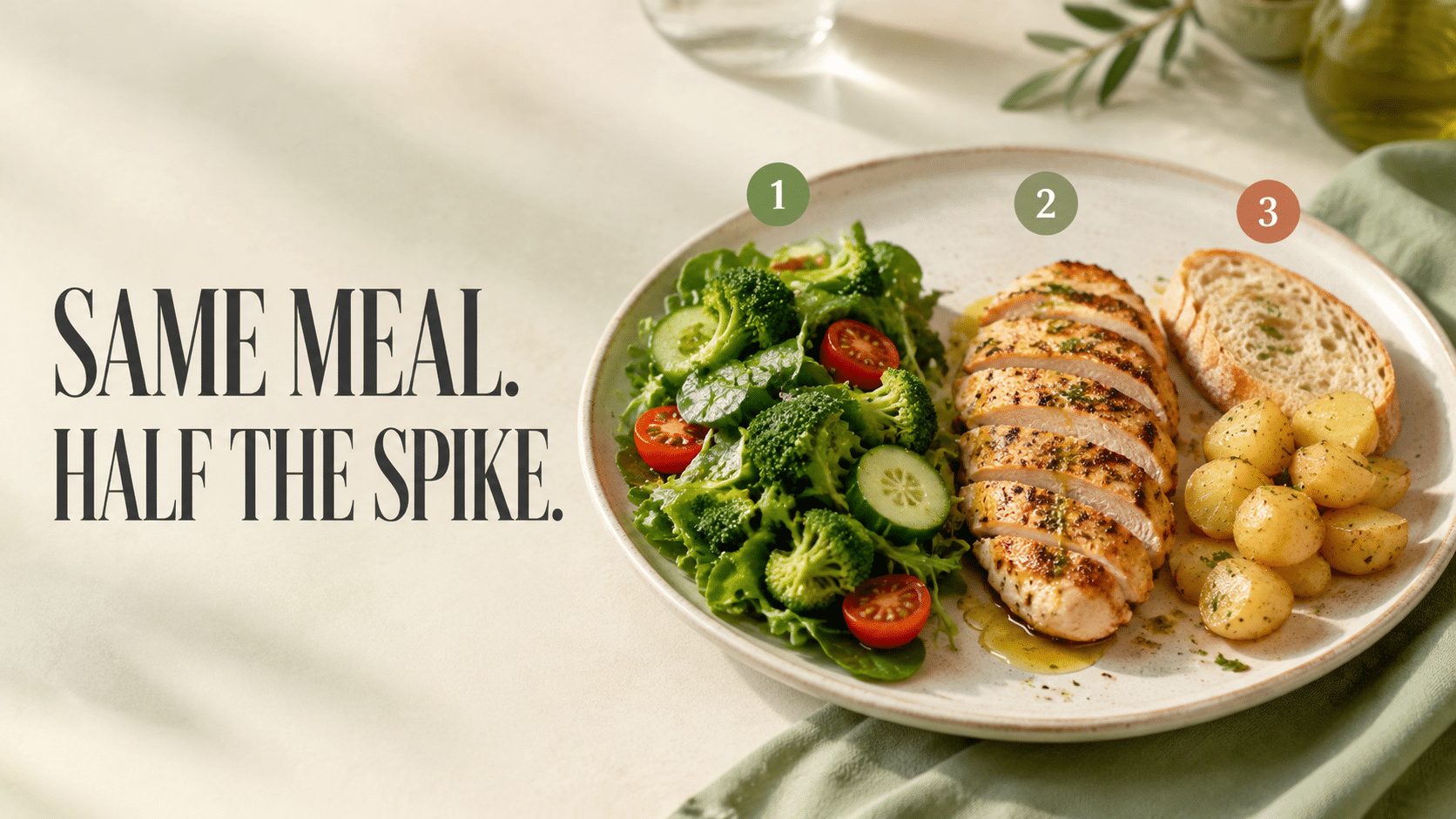
Most diet advice starts with a list of things you can’t have. It’s exhausting, and it rarely lasts, because willpower is a finite resource. Food sequencing for blood sugar offers a different approach: instead of giving up the foods you enjoy, you change the order in which they reach your stomach.
Food sequencing flips the question. Instead of asking what you eat, it asks in what order. You keep the same meal — the bread, the pasta, the glass of juice — and simply eat the components in a smarter sequence. It costs nothing, requires no special ingredients, and doesn’t ask you to cut a single food you love.
It isn’t a magic pill, and no honest article should sell it as one. But it’s one of the rare habits that is genuinely free, easy to sustain, and backed by real clinical data. Here’s what the science actually says, why it works, and exactly how to do it at your next meal.
What the research actually found
The idea was put on the map by a small 2015 study led by Dr. Alpana Shukla and colleagues at Weill Cornell, published in Diabetes Care. The design was elegant: eleven adults with type 2 diabetes ate the exact same meal — a lettuce-and-tomato salad with steamed broccoli, grilled chicken, and ciabatta bread with orange juice — on two separate days. The only thing that changed was the order.
When they ate the carbohydrates last (vegetables and protein first, bread and juice at the end), their post-meal glucose ran meaningfully lower: roughly 29%, 37%, and 17% lower at the 30-, 60-, and 120-minute marks. Measured as the total glucose “load” after the meal — the incremental area under the curve — the carbohydrate-last order came out about 73% lower than the carbohydrate-first order.
Two honest caveats matter here. First, this was a small pilot in people who already had type 2 diabetes, so the exact percentages shouldn’t be read as a universal law for everyone. Second, that’s the good news: the effect has since been replicated in prediabetes, in gestational diabetes, and in continuous-glucose-monitoring studies, which is why it’s now taken seriously rather than dismissed as a fluke. The popular wellness movement around “eating in order” (notably Jessie Inchauspé’s Glucose Goddess work) helped bring this research to a mass audience — the underlying evidence, though, predates the hashtags.
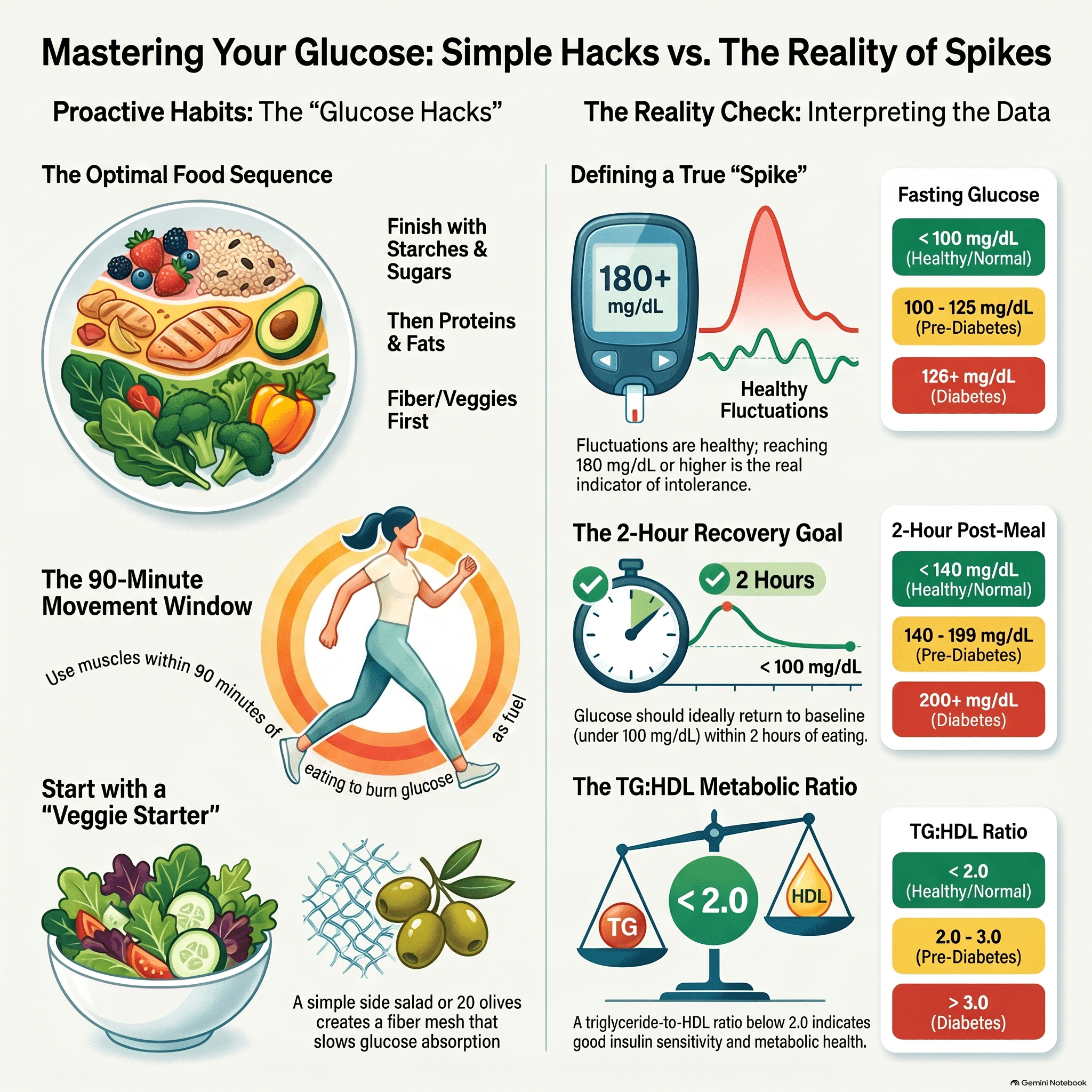
How food sequencing for blood sugar works
When you eat carbohydrates on an empty stomach, they’re digested quickly and glucose floods into your bloodstream in a sharp, early spike. Eating fiber and protein first changes the physics and the chemistry of that process in a few well-documented ways:
- It slows gastric emptying. Fiber and protein slow the rate at which your stomach hands food off to the small intestine, so the sugar from the carbohydrates arrives in a slow trickle rather than a flood.
- It thickens what’s in your stomach. Soluble fiber forms a viscous gel that physically slows how fast glucose reaches the gut wall to be absorbed.
- It nudges your gut hormones. Eating protein and fiber first stimulates incretin hormones like GLP-1, which improve your insulin response and further blunt the rise.
This is why food sequencing for blood sugar can change the glucose response even when the foods and portions remain the same.
Notice what’s not happening: fiber doesn’t build a “shield” or a mesh lining your intestine. The benefit is about timing and rate — turning a fast spike into a gentle slope. Flatter glucose curves also mean fewer of the sharp insulin surges and the “crash-and-crave” cycle that often follows a spike.
The three-step order
- Fiber first — non-starchy vegetables
- Protein and fats next — meat, fish, eggs, tofu, cheese, nuts, olive oil
- Carbohydrates and sugars last — bread, rice, pasta, potatoes, fruit, dessert, juice
Here’s a quick reference for building meals around it:
| Eat First: Fiber | Eat Next: Protein & Fats | Eat Last: Carbs & Sugars |
|---|---|---|
| Broccoli, kale, artichoke | Chicken, fish, eggs | Bread, pasta, bagels |
| Brussels sprouts, cabbage, cauliflower | Beef, turkey, tofu | Rice, barley, couscous |
| Spinach, lettuce, tomatoes | Cheese, Greek yogurt, nuts | Potatoes, corn |
| Asparagus, mushrooms, olives | Avocado, olive oil, seeds | Fruit juice, soda, cake |
Liquid sugars — juice and soda — are the hardest to buffer because they hit fast and there’s no fiber or fat to slow them. If anything earns the “save it for last, or skip it” rule, it’s these.
A few extras that may help blunt a spike
Sequencing is the main lever. But a handful of herbs and minerals have some human evidence for softening the glucose rise, and they pair naturally with meals. None of these is a substitute for the order above — or for medication . Think of them as optional add-ons.
Herbs and spices
- Cinnamon. Some studies suggest it slightly lowers post-meal glucose, possibly by slowing carbohydrate digestion. The evidence is mixed and the effect is small. Favor Ceylon cinnamon, which is much lower in coumarin than the common cassia type — large, regular doses of cassia can stress the liver.
- Fenugreek. Its soluble fiber and mild effect on GLP-1 can modestly reduce both fasting and post-meal glucose. Easy to add as seeds or in cooking. Skip it if you’re pregnant.
- Berberine. This plant compound has the strongest human evidence of the bunch for lowering glucose — but it’s really a supplement, not a seasoning, and it has meaningful drug interactions and can cause digestive upset. If you want to try it, treat it like a medication and talk to a clinician first.
- Bitter melon and gymnema have long traditional use and plausible mechanisms, but trial results are inconsistent.
Minerals
- Magnesium has the most consistent evidence, especially for people running low — it’s linked to better fasting glucose and insulin sensitivity. Leafy greens, nuts, seeds, legumes, and dark chocolate are good food sources.
- Zinc has shown reductions in fasting and post-meal glucose in several trials, though results vary. Found in shellfish, meat, and pumpkin seeds.
- Chromium may help modestly, mostly in people who are deficient; the evidence is mixed.
A real caution: if you take glucose-lowering medication, several of these (berberine and chromium in particular) can add to that effect and push blood sugar too low. Get food and supplements right with your doctor, not around them.
How to actually do it
Food sequencing for blood sugar becomes much easier when you reduce it to three simple decisions at each meal.
- Start with a “veggie starter.” Before you touch the main dish, eat a dedicated portion of vegetables — a side salad, a handful of olives, some roasted greens. This is the single highest-leverage habit.
- Eat protein and fat before starch. Your chicken, eggs, or fish before your rice or bread.
- Save the sweet and starchy for the end. Bread, dessert, and juice do the least damage when they land last.
- Beware the bread basket. Bread on an empty stomach is the classic early spike — and the crash 90 minutes later is what drives you toward dessert. Ask for it with the meal, and use it to mop up at the end.
After the meal, a short walk or a few calf raises can provide another layer of support. Learn more about the connection between the gastrocnemius and insulin sensitivity.
A quick note on who should check first
This is general information, not personal medical advice. Food order supports glucose control — it doesn’t cure or replace treatment for diabetes. If you have diabetes or prediabetes, take insulin or other glucose-lowering drugs, are pregnant, or are considering any of the supplements above, run it past your doctor first, especially since better glucose control can mean your medication doses need adjusting.
Start with your next meal
You don’t need a new grocery list, a subscription, or a single ounce of willpower spent on saying no. You need thirty seconds and a small decision: vegetables first, protein next, the good stuff last.
Food sequencing for blood sugar isn’t about perfection; it’s about making one small, repeatable change.
So here’s the challenge — do it once, today. At your very next meal, eat in order. Notice the steadier energy, the absence of the afternoon slump, the way the cravings quiet down. One meal is all it takes to feel the difference. Then do it again tomorrow. That’s the whole method — and it’s already in your hands.
