
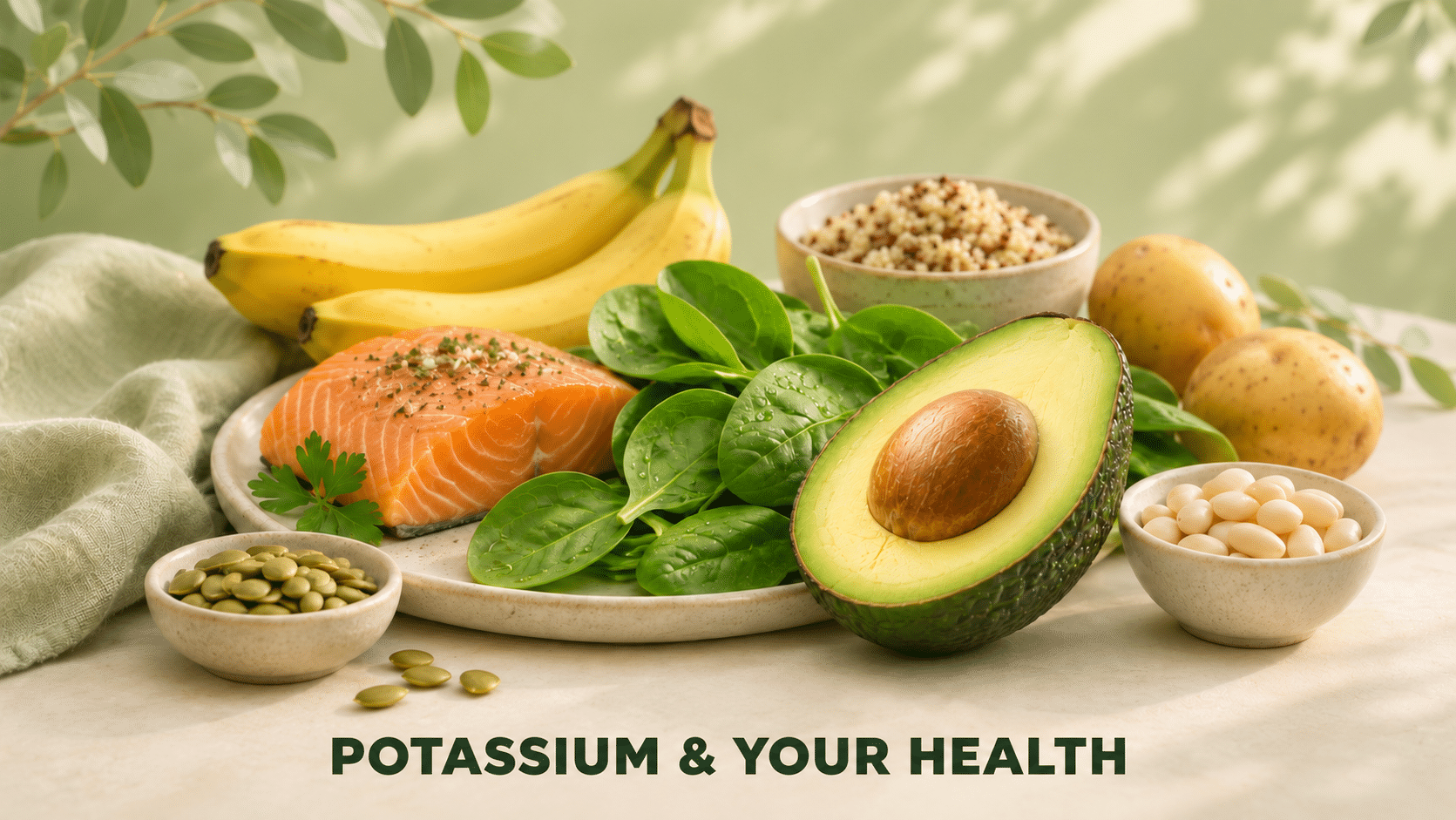
I’ve put this article together using information Carol and I gathered while preparing for our recent Take Charge of Your Health radio show on potassium.
I’m also trying something a little different with this post. I’ve included AI-generated infographics to help illustrate some of the fascinating ways potassium works in our bodies. Sometimes a picture makes a complicated process much easier to understand.
This is a new format for me, and I’d really like to hear what you think. Do the illustrations help bring the information to life? Let me know in the comments. Your feedback will help me decide whether to use more of these in future articles.
The Biological Battery: How Potassium Powers Your Cells
To understand potassium, we first have to ask a fundamental question: what makes a mineral an electrolyte? When dissolved in water, an electrolyte splits into electrically charged ions capable of conducting electricity. Potassium ($K^+$) carries a positive charge and acts as the dominant positive ion inside your body’s cells.
Roughly 98% of all potassium in your body resides inside your cells—primarily within muscle tissue—while a microscopic 2% circulates in your blood. The concentration of potassium inside a cell is about 30 times higher than outside. How does the body maintain such a massive concentration gap?
It relies on a microscopic, molecular machine embedded in every cell membrane: the sodium-potassium pump ($Na^+/K^+$ ATPase). Imagine this pump as a microscopic biological battery charger. It expends raw cellular energy in the form of ATP to forcefully pump three sodium ions ($Na^+$) OUT of the cell while pulling two potassium ions ($K^+$) IN.
How the Cellular Battery Creates Voltage
Because both ions carry positive charges, ejecting three positive ions while taking back only two creates a net negative charge inside the cell relative to the outside. This difference in electrical potential creates a voltage—a literal cellular battery!
This single biological mechanism is so crucial that it consumes roughly 30% of all the energy your body burns at rest. This electrical voltage powers:
– Nerve transmission: Sending lightning-fast signals throughout your nervous system.
– Muscular contraction: Allowing your skeleton, heart, and digestive colon (peristalsis) to flex and relax.
– Acid-Base (pH) balance: Enabling stomach enzymes like pepsin to activate for protein digestion.
Crucially, this pump cannot run without magnesium. Magnesium acts as the biological key that unlocks the ATP energy needed to power the pump. Without sufficient magnesium, the sodium-potassium pump falters, draining your cellular batteries regardless of how much potassium is nearby.
The Insulin Dynamic: Why Blood Sugar and Potassium Are Inseparable
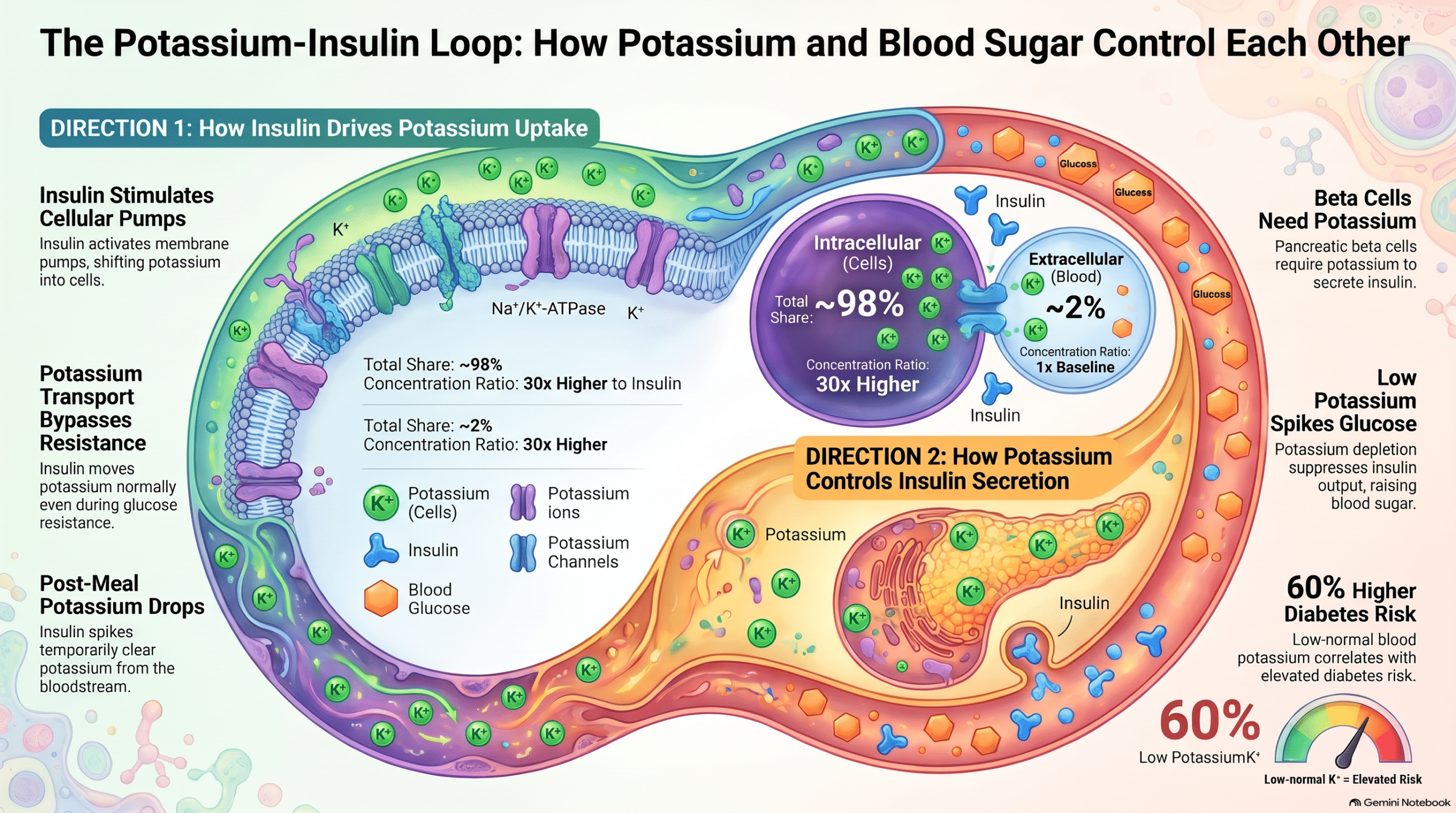
Most people know insulin as the hormone that shuttles glucose out of the blood and into cells after a meal. However, insulin has a secondary, equally vital job: it is one of the primary regulators of potassium distribution.
When you eat carbohydrates, blood glucose rises, sparking an immediate release of insulin from the pancreas. Within minutes, insulin signals the sodium-potassium pumps on your cell membranes to work overtime and multiplies the total number of active pumps. The result? Potassium is rapidly moved from the blood into the cells alongside glucose.
This rapid shifting reveals a critical clinical trap: your blood test can lie to you. Because only 2% of your total potassium resides in the blood, a high-carbohydrate meal can cause blood potassium levels to temporarily drop as potassium shifts inside cells—even if your body’s overall potassium stores are completely healthy.
What happens in insulin resistance or Type 2 diabetes? While the body becomes resistant to insulin’s ability to clear blood glucose, research reveals that insulin’s ability to move potassium into cells remains entirely intact. Because insulin is chronically elevated in insulin-resistant individuals, this potassium-shifting effect remains perpetually active.
The Two-Way Relationship With Insulin
However, this hormonal relationship is a two-way street. While insulin moves potassium, pancreatic beta cells require potassium to release insulin in the first place!
Microscopic potassium channels on the surface of pancreatic beta cells sense intracellular potassium levels to signal the release of insulin packages into the bloodstream.
In clinical clamp studies, when healthy individuals were rendered potassium-deficient:
– Their insulin release fell by approximately 25%.
– Their ability to clear blood sugar dropped by a quarter.
– Their tissue sensitivity to insulin remained unchanged, proving that low potassium directly impairs insulin production.
Standard blood tests define normal potassium between 3.5 and 5.0 mEq/L. Yet, longitudinal studies tracking over 12,000 adults for nine years revealed that individuals at the lower end of normal (near 3.5 mEq/L) had a 60% higher risk of developing diabetes compared to those at the top end of the range. Even subtle, unflagged dips in potassium can quietly compromise blood sugar control.
The Pressure Valve: Aldosterone, the Kidney Switch, and Blood Pressure
If insulin manages potassium on a minute-to-minute basis by pushing it into cells, who manages potassium over hours and days? Enter aldosterone, a hormone produced by the adrenal glands sitting atop your kidneys.
Aldosterone’s primary job is to tell the kidneys to hold onto sodium and flush out potassium into the urine. Together, insulin and aldosterone divide the labor of fluid and electrolyte management:
– Insulin (Rapid Response): Acts in minutes after a meal to pull excess potassium into cells, protecting the bloodstream from dangerous spikes.
– Aldosterone (Long-term Regulation): Acts over hours in the kidneys to adjust how much potassium exits the body in urine.
When blood potassium rises, it directly signals the adrenal glands to release aldosterone, prompting the kidneys to dump the extra potassium. But there is a catch: both insulin and aldosterone tell the kidneys to retain sodium and water.
In a person with chronic insulin resistance, insulin levels are high around the clock. This creates a double-whammy: elevated insulin and elevated aldosterone both command the kidneys to clamp down on sodium and water. Extra fluid accumulates in the bloodstream, driving up arterial volume and causing hypertension (high blood pressure).
The Kidney’s Potassium Switch
Inside the functional units of the kidney, potassium controls a master mechanism known as the potassium switch—specifically regulating a salt gatekeeper called the NCC (sodium-chloride transporter):
– When potassium intake is LOW: The kidney activates the NCC gatekeeper, telling the body, “Hold onto sodium at all costs!” Sodium builds up, pulling water into the vessel walls and spiking blood pressure.
– When potassium intake is HIGH: The NCC gatekeeper shuts down. The kidneys rapidly flush sodium and water out into the urine, relaxing blood vessels and lowering blood pressure.
This explains why the sodium-to-potassium ratio is far more critical than sodium intake alone. Ancestral evidence suggests Stone Age humans consumed up to 15,000 mg of potassium daily—a 16:1 ratio of potassium to sodium. Modern diets have inverted this ratio, leaving the kidney’s potassium switch permanently stuck in sodium-retention mode.
Beware of blood pressure medications like standard water pills (diuretics). While they force the kidneys to dump sodium and fluid, many simultaneously drain potassium. Draining potassium lowers insulin release from the pancreas, paradoxically worsening blood sugar control while trying to treat blood pressure!
Fasting, Keto, and the Danger of Refeeding
When you fast or adopt a strict low-carbohydrate ketogenic diet, your body undergoes a dramatic hormonal shift. As carbohydrate intake drops to zero, insulin levels plunge.
Without insulin instructing the kidneys to retain sodium, the body enters a state of rapid fluid excretion—often called the “keto flush.” You shed pounds of water weight within the first few days. However, this fluid loss drops blood pressure, signaling the adrenal glands to pump out aldosterone to save remaining sodium. As aldosterone rises, it aggressively pushes potassium out into the urine.
Simultaneously, as the liver produces mildly acidic ketone bodies, the kidneys flush out sodium and potassium alongside these ketones. Over the course of a week-long fast, the body can lose up to 12 grams of potassium—roughly 3 to 4 days’ worth of total dietary requirement.
To keep blood potassium within a safe living window (3.5–5.0 mEq/L), your body’s muscle tissues slowly sacrifice their internal potassium stores into the blood. Consequently, a blood test during a extended fast can look perfectly normal even while total body potassium is severely depleted.
What Happens When a Long Fast Ends
This sets up a dangerous metabolic trap when ending a fast, known as Refeeding Syndrome:
After days of fasting, total body potassium is depleted, though blood levels appear normal.
The fast is broken with a large, high-carbohydrate meal (e.g., pastries, pasta, or sugary drinks).
Glucose surges, triggering a massive, rapid insulin spike.
Reawakened insulin forcefully signals every pump in the body to drive blood potassium into empty cellular stores all at once.
Blood potassium levels plunge off a cliff (hypokalemia).
Without adequate potassium circulating in the blood, the heart’s electrical rhythm destabilizes. Heart cells become spastic, leading to fatal cardiac dysrhythmias—the heart simply stops beating.
To break a fast safely, especially multi-day fasts:
Never break a fast with refined carbohydrates or high-glycemic foods.
Begin with a modest meal composed of proteins and natural healthy fats (e.g., eggs, fish, avocado).
Protein and fats produce a minimal insulin response, allowing cells to gently absorb glucose and potassium without draining the blood.
Fixing the Deficiency: Dietary Powerhouses vs. Common Myths
If 97% of people fail to meet the 4,700 mg RDA for potassium, why not simply take a potassium pill?
By law, over-the-counter potassium supplements are capped at just 99 milligrams per pill to prevent concentrated localized burn injuries to the intestinal lining. To hit your daily requirement via pills alone, you would need to swallow 47 tablets every day! Real whole foods remain the safest, most effective delivery vehicle.
However, popular wisdom regarding potassium sources is full of misconceptions:
Bananas: Commonly hailed as the ultimate potassium food, a single banana contains only ~300 to 420 mg of potassium alongside 27 grams of sugar. You would need to eat 12 to 15 bananas daily—consuming over 350 grams of sugar—to hit your requirement.
Potatoes & Plantains: While rich in potassium (~600 mg per medium potato), they are dense starches that rapidly break down into simple sugars, causing sharp insulin spikes.
Choosing Potassium-Rich Foods
To maximize potassium without blood sugar spikes, prioritize low-glycemic, nutrient-dense whole foods:
Avocado: The ultimate potassium powerhouse. One whole avocado provides 700 to 800 mg of potassium, zero starch, abundant healthy monounsaturated fats, and a rich supply of magnesium.
Wild-Caught Salmon: A 6 oz fillet delivers up to 970 mg of potassium, high-quality protein, anti-inflammatory omega-3 fatty acids, and zero carbohydrates.
Cooked Leafy Greens: Cooked Swiss chard delivers up to 1,300 mg, beet greens provide 1,300 mg, and cooked spinach provides 840 mg per cup.
Portobello Mushrooms & Tomato Paste: One cup of sautéed portobello mushrooms contains ~530 mg; just 2 tablespoons of tomato paste delivers ~400 mg.
Critical Culinary Tip: Potassium is water-soluble. If you boil spinach or Swiss chard in a large pot of water and drain it, the potassium leeches directly into the discarded cooking water! To preserve potassium, sauté or steam your green vegetables instead.
Finally, remember the Magnesium Connection. If you suffer from chronic potassium deficiency symptoms—such as muscle cramps, fatigue, constipation, or heart palpitations—check your magnesium intake. Magnesium is required to build the cellular energy (ATP) that runs the sodium-potassium pump and prevents the kidneys from wasting potassium. Without magnesium, potassium simply runs right through you!
Summary
Potassium is far more than a simple mineral; it is the fundamental fuel for your body’s cellular batteries, insulin production, and blood pressure regulation. Maintaining adequate potassium through low-glycemic whole foods and protecting your electrolytes during dietary transitions is essential for lifelong metabolic health.
Key Takeaways:
Cellular Power: The sodium-potassium pump consumes 30% of resting body energy to pump 3 $Na^+$ out and 2 $K^+$ in, establishing cellular voltage for nerves, muscles, and fluid balance.
Insulin Crosstalk: Insulin pushes potassium into cells within minutes. Conversely, pancreatic beta cells require potassium to produce insulin. Low potassium reduces insulin release by ~25% and increases diabetes risk.
Blood Pressure Regulation: High potassium turns off the kidney’s NCC sodium transporter, flushing out excess sodium and water to naturally lower blood pressure.
Refeeding Warning: Fasting depletes whole-body potassium stores. Breaking long fasts with high-carbohydrate meals causes a severe insulin spike that can plunge blood potassium to lethal levels.
Smart Nutrition: Avoid high-sugar sources like bananas. Choose avocados, wild salmon, and sautéed (not boiled) leafy greens, always pairing potassium with adequate magnesium.
Further Reading
- NIH Office of Dietary Supplements — Potassium
- National Academies — Dietary Reference Intakes for Sodium and Potassium
