
Most people hear “creatine” and think of muscles, exercise, or a container of powder on a gym shelf. Yet researchers have also been giving it to people struggling with depression, testing memory in older adults, and looking at what happens when someone has been awake all night. These studies bring us to another part of the body that depends on a steady supply of energy: the brain. That is the side of creatine we explored on Take Charge of Your Health, and it is the focus of this article.
Remembering a conversation, following directions, and working through a problem all require energy. Brain cells use a molecule called ATP to carry out that work, and they continually recycle it as energy is spent. Creatine helps replenish ATP through a stored form called phosphocreatine. The same system that supports working muscles also operates in brain tissue.
Your body makes creatine, and meat and fish supply some through food. A supplement provides an additional source, usually as creatine monohydrate. Researchers have studied whether that extra supply changes memory, mood, or mental performance under particular conditions. The people in these studies, what they took, and what changed help explain why this familiar supplement has become part of the conversation about brain health.
Creatine and memory: what people were able to do
Working memory is what you use to hold information in mind while doing something with it. Remembering a set of directions long enough to follow them is one example. In a study of 45 young vegetarian adults, participants took five grams of creatine daily for six weeks. They improved at repeating numbers backward and at solving visual problems that required them to recognize patterns. [2]
Older adults have also taken part in memory testing. In one study of 32 people aged 68 to 85, the group receiving the supplement took 20 grams daily for one week after a week on placebo. Performance improved on several tasks involving number recall, spatial memory, and longer-term recall. Repeating numbers backward did not improve significantly, so the changes depended on the task being tested. [9]
Food intake is another part of this picture. Vegetarian and vegan diets supply very little creatine because its main food sources are meat and fish. In a separate study comparing vegetarian women with women who ate meat, five days of supplementation improved memory among the vegetarians. The body still makes its own supply, and eating little dietary creatine does not by itself establish a brain deficiency. [8]
Creatine and mood: adding to depression treatment
Energy production is also being studied in people with depression. In an eight-week trial, 52 women received the antidepressant escitalopram, with either five grams of creatine daily or a placebo. The women receiving the supplement had greater improvement in their depression scores by the second week. That difference was still present at four and eight weeks; the supplement was being used alongside their medication. [1]
When researchers combined 11 trials involving 1,093 people in a 2025 review, the average improvement was smaller than the difference they had defined as clinically important. Results differed across the trials, and the certainty of the evidence was very low. This means the improvement seen in one group cannot be assumed for everyone with depression. A separate bipolar-depression trial reported mania or hypomania in two participants taking creatine, so anyone with bipolar disorder should discuss it with their treating clinician before starting. [7] [6]
What happens when you lose sleep?
After a night without sleep, keeping track of information and responding quickly become harder. A 2024 experiment examined whether creatine changed those effects in 15 adults. Each person completed two sessions, receiving the supplement in one and a placebo in the other. Researchers measured performance on mental tasks and used scans to examine brain-energy compounds. [3]
The dose was a single 0.35 grams per kilogram of body weight—about 24.5 grams for a person weighing 154 pounds. During sleep deprivation, participants performed better on selected memory and processing-speed tasks after taking it, and brain-energy measurements also changed. This was a high-dose laboratory experiment, rather than a daily supplement regimen. It does not establish that a large dose can replace sleep. [3]
Research during recovery from brain injury
Researchers have also examined creatine during recovery from traumatic brain injury. An early pilot involved 39 children and adolescents, with reports describing changes in post-injury memory loss and symptoms such as headache, dizziness, and fatigue. Families and clinicians knew who was receiving treatment, so this was an open-label study. The treatment took place within medical care; these results do not establish a home treatment for concussion. [11] [12]
How creatine supports brain energy
Think about how much your brain does while you are simply sitting and reading. Cells send signals, maintain their electrical balance, and process incoming information. Those jobs require ATP, which releases energy when it loses a phosphate group and becomes ADP. The sodium-potassium pump is one example of a cellular process powered by ATP.
Creatine participates in the recharging step. A cell can store it with a phosphate attached, forming phosphocreatine. When ATP is needed, an enzyme called creatine kinase transfers that phosphate to ADP, making ATP available again. Meanwhile, the mitochondria and other energy-producing pathways continue their work.
Getting extra creatine into the brain takes more than getting it into the bloodstream. Brain tissue makes some of its own, and transport proteins regulate movement across cell barriers. In an imaging study of six healthy volunteers, 20 grams daily for four weeks increased average total brain creatine by about 8.7%. The amount of change differed between people and brain regions. [13]
Choosing a form and understanding the amounts
Creatine monohydrate is the form used in the principal studies discussed here. You will see other forms sold at higher prices, but they have not been shown to be superior for the established exercise uses. A label should tell you the amount in a serving, and independent testing can help check product contents. A scoop is not a universal measure, so read the gram amount on the container. [14]
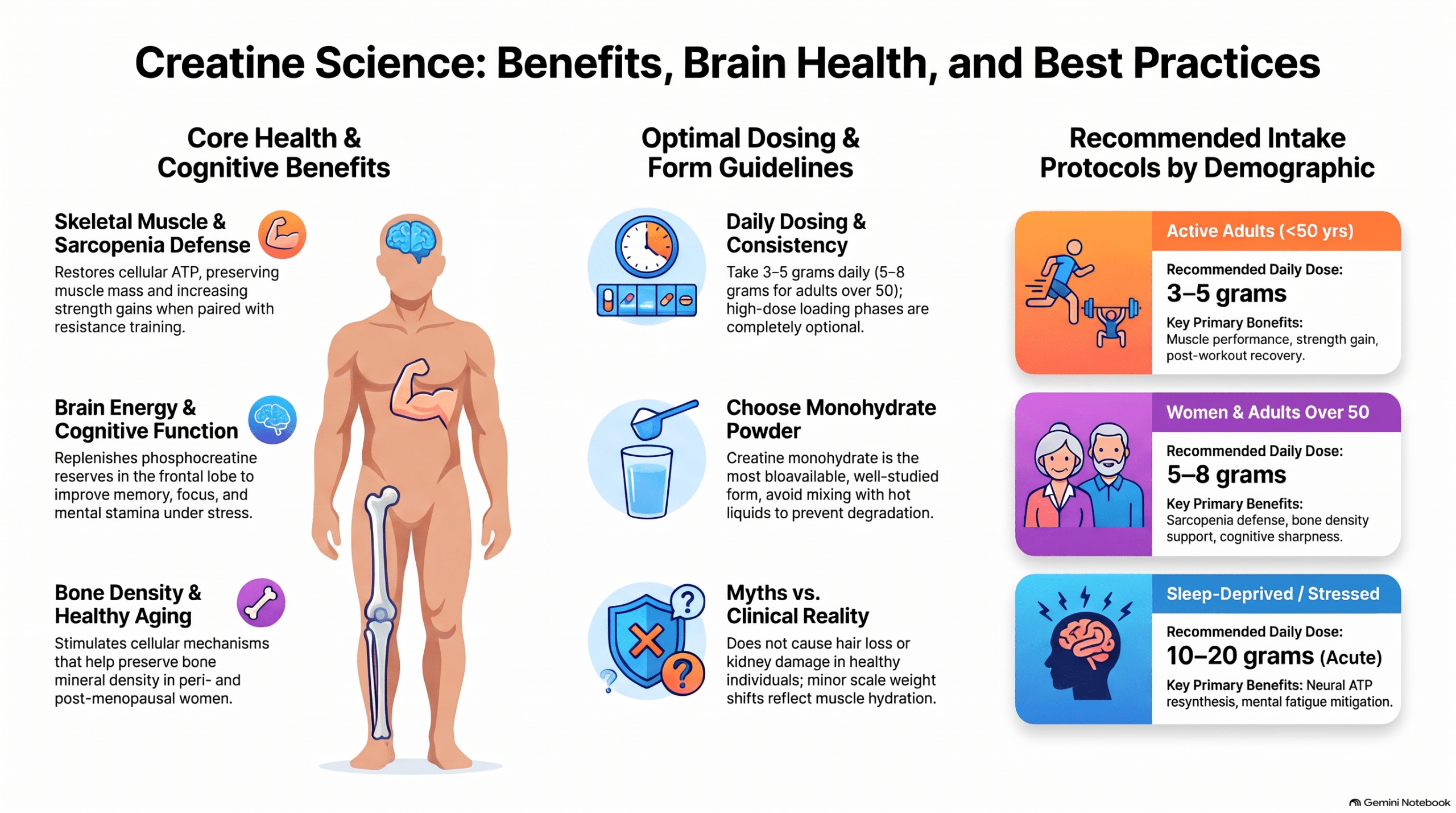
Open the infographic at full size.
For established exercise uses, three to five grams daily is a common maintenance amount. Brain studies have used a range of regimens: five grams daily for several weeks in some trials, and larger amounts over shorter periods in others. There is no single established dose for improving memory or treating depression. The table below shows what the individual researchers used, rather than a dosing plan for every reader. [14] [1] [2] [3] [9]
| Study | Amount | Duration |
|---|---|---|
| Women taking escitalopram [1] | 5 g daily | 8 weeks |
| Vegetarian adults: memory [2] | 5 g daily | 6 weeks |
| Older adults: memory [9] | 20 g daily | 1 week |
| Sleep deprivation [3] | 0.35 g/kg | Single dose |
Larger servings can cause stomach discomfort or diarrhea. Dividing a larger daily amount into smaller servings may improve tolerance. If you are considering it for memory or mood, bring your medication list and the product label to your clinician. The study dose, your health history, and the reason for taking it all belong in that discussion. [14]
Creatine and kidney blood tests
Creatine and creatinine sound similar, but they are different compounds. Creatinine is a breakdown product measured in blood tests to help estimate kidney filtration. Taking a creatine supplement can raise that reading without a corresponding decline in kidney function. In a short trial of healthy young men taking three or five grams daily, researchers found no evidence of kidney injury on the additional markers they measured. [15]
Tell the clinician ordering your blood work if you take it, including how much and for how long. A change in creatinine still needs to be interpreted in context, rather than automatically attributed to a supplement. If you already have kidney disease or abnormal kidney tests, discuss supplementation before starting. Studies in healthy volunteers do not answer every question about an individual with kidney disease.
At home, start by looking at what you already take and what you hope to change. Write down the products and amounts, whether your concern is memory, low mood, or fatigue, and how sleep has been. Bring that information to your next appointment. It gives you and your practitioner a concrete starting point for deciding whether creatine belongs in your plan.
Compiled from research gathered for Take Charge of Your Health with Corinne & Carol.
Human studies and references
- Lyoo et al. (2012). Randomized, double-blind trial of creatine augmentation of escitalopram in 52 women with major depressive disorder. PubMed.
- Rae et al. (2003). Placebo-controlled crossover study of 5 g/day for six weeks in 45 vegetarian adults. PubMed.
- Gordji-Nejad et al. (2024). Single-dose creatine, brain energy metabolites, and cognitive performance during sleep deprivation. Full paper.
- McMorris et al. (2006, 2007). Sleep-deprivation studies discussed in the systematic review by McMorris et al. (2024). Review. The studies involved sleep loss with intermittent exercise.
- Kondo et al. (2011). Open-label adjunctive creatine study in five adolescent females with SSRI-resistant depression. PubMed.
- Toniolo et al. (2018). Randomized proof-of-concept trial in bipolar depression. PubMed.
- Eckert et al. (2025). Systematic review and meta-analysis of creatine for depressive symptoms. PubMed.
- Benton and Donohoe (2011). Cognitive testing in vegetarian and omnivorous women after short-term supplementation. PubMed.
- McMorris et al. (2007). Creatine supplementation and cognitive performance in older adults. PubMed.
- McMorris et al. (2024). Systematic review of brain creatine and cognitive outcomes. PubMed.
- Sakellaris et al. (2006). Open-label randomized pediatric traumatic brain injury pilot. PubMed.
- Sakellaris et al. (2008). Pediatric pilot report on headache, dizziness, and fatigue after traumatic brain injury. PubMed.
- Dechent et al. (1999). Brain magnetic resonance spectroscopy after 20 g/day for four weeks in six volunteers. PubMed.
- Office of Dietary Supplements, National Institutes of Health. Dietary Supplements for Exercise and Athletic Performance. Source.
- Vilar Neto et al. (2020). Placebo-controlled trial using kidney injury biomarkers during creatine supplementation. Source.
